Most UK home heating advice is written with gas boilers in mind. When guides talk about pressure drops, short cycling, or radiators that lose heat quickly, they are almost always describing the behaviour of a mains gas combination boiler connected to a wet central heating system. For the estimated 1.7 million UK households that heat their homes with oil or LPG, much of this advice applies directly, but the specific symptoms, causes, and fixes differ in ways that matter when you are trying to work out what is wrong.
Understanding where oil and LPG systems overlap with gas and where they diverge helps you use WarmGuide’s diagnostic content more effectively and avoid misdiagnosing a problem that has a different root cause in your system type. If you are not sure where to start, the house cold diagnostic covers the most common heating problems and routes you to the relevant guide regardless of fuel type.
What oil and LPG boilers have in common with gas
The fundamentals of a wet central heating system are identical regardless of fuel source. An oil or LPG boiler heats water in the same way a gas boiler does, circulates it through the same type of radiator circuit, and responds to the same thermostat and programmer controls. The radiators, the pipework, the expansion vessel, the pressure gauge, and the circulating pump all function in the same way. The radiator problems covered in WarmGuide’s guides, radiators cold at the bottom, radiators that lose heat during the cycle, uneven heating across the house, apply equally to oil and LPG systems because they are caused by what happens in the pipework and radiators, not by how the fuel burns.
Balancing the radiators, bleeding trapped air, checking TRV function, and addressing sludge buildup are all relevant maintenance tasks for oil and LPG systems exactly as they are for gas. The radiator balancing guide applies directly. So does the advice on draught-proofing and why homes lose heat quickly after the heating turns off, those are building fabric issues that have nothing to do with the boiler fuel type.
How oil boilers differ from gas in practice
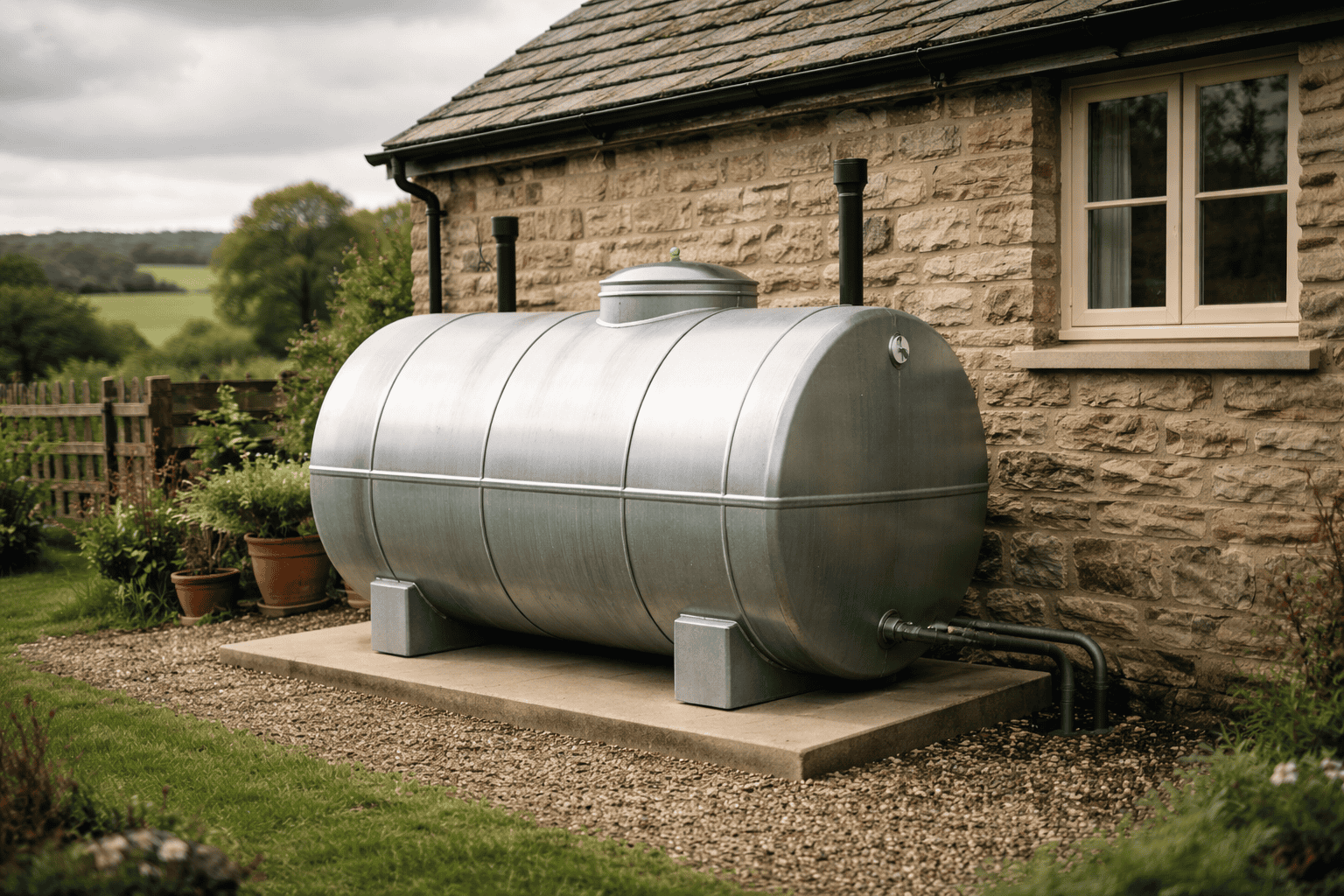
The most significant practical difference between an oil boiler and a gas boiler is that oil is stored on site in a tank rather than supplied continuously through a pipe. This creates a category of problem that gas systems simply do not have. If the oil tank runs low or the fuel supply line develops a blockage or airlock, the boiler will stop firing regardless of whether the boiler itself is in good working order. A gas boiler that stops firing almost never has a fuel supply problem, it either has an ignition fault, a pressure issue, or a component failure. An oil boiler that stops firing may have any of those faults or may simply have run out of fuel or developed a fuel feed problem.
Oil boilers also use a pump and nozzle system to atomise the oil before igniting it. This nozzle requires periodic replacement, typically annually as part of a service, and when it degrades or becomes partially blocked it produces an incomplete burn that reduces efficiency, produces more soot, and can cause the boiler to fire then cut out, a symptom that on a gas boiler would point toward a pressure or sensor fault. If your oil boiler is firing then switching off, the nozzle condition and fuel supply are the first things to check before investigating the same causes you would check on a gas system.
Oil boilers typically have a fuel filter between the tank and the boiler that catches debris and water contamination. If this filter becomes blocked, fuel flow is restricted and the boiler behaves as if it has a firing problem. Replacing or cleaning the filter is a straightforward maintenance task that often resolves intermittent firing issues that would be attributed to sensor faults on a gas system.
Cold weather affects oil boilers more directly than gas boilers. Heating oil can thicken and even partially gel in very cold temperatures, which restricts flow through the fuel line and filter. This is most likely when the oil tank is located outside and exposed to low temperatures. If an oil boiler performs poorly specifically during cold snaps, fuel viscosity and the condition of the external pipework insulation are worth checking alongside the boiler components. For gas boilers, boiler struggles in cold weather are almost always caused by increased heat demand rather than fuel supply issues.
How LPG systems differ from both oil and gas
LPG boilers are technically very similar to gas boilers, they use the same burner principle and the same type of controls, and many gas boiler models can be converted to run on LPG with a conversion kit. The practical differences are more about the supply arrangement than the boiler itself.
LPG is stored in a tank or bottles at higher pressure than a gas main supply. The pressure regulator between the tank and the boiler reduces this to a safe working pressure, and if this regulator fails or the LPG runs low, the boiler will lose pressure and either fire weakly or cut out entirely. This is similar to the oil supply problem described above but is more likely to present as reduced output rather than complete failure, because LPG pressure drops gradually as the tank empties rather than cutting off suddenly as oil might.
In very cold conditions, LPG vaporisation from the tank slows, which can cause a temporary pressure drop that mimics a regulator fault. This typically resolves as temperatures rise. If an LPG boiler cuts out repeatedly overnight in winter but works normally during the day, low ambient temperature affecting vaporisation is worth considering before calling an engineer.
Because many LPG households are tied to a single supplier through a tank rental contract, LPG supply issues can be harder to resolve quickly than oil supply issues where any supplier can make a delivery. The current price situation for LPG households is covered in detail in the guide to why the Iran conflict is hitting oil and LPG households harder than gas.
Servicing requirements and why they matter more for oil
All boilers benefit from annual servicing, but for oil boilers it is more critical and more consequential if skipped. A gas boiler that misses a service may become slightly less efficient but will typically continue to function. An oil boiler that misses a service accumulates soot deposits in the combustion chamber, the nozzle degrades, and the heat exchanger efficiency drops meaningfully. An unserviced oil boiler running at 70% efficiency is burning roughly 30% more fuel for the same heat output compared to a properly serviced one at 85 to 90% efficiency.
This makes the efficiency argument for regular servicing considerably stronger for oil than gas, and it also means that a sudden rise in oil consumption without an obvious explanation is often a servicing issue rather than a usage change. If your oil bills have crept up significantly over two or three years without a change in how you heat the home, a service is the first thing to check.
Pressure behaviour in oil and LPG systems
The pressure behaviour of the central heating circuit, the closed wet system of pipes and radiators, is identical in oil, LPG, and gas systems. If your system is losing pressure, the causes are the same regardless of fuel type: a leak in the system, a failing pressure relief valve, or a deteriorating expansion vessel. The fact that the heat source is oil or LPG rather than gas does not change how the circuit itself behaves.
Where pressure behaviour differs is in the fuel supply side. Oil and LPG systems have fuel supply pressure components, the oil pump, the LPG regulator, that gas systems do not. If your boiler’s combustion pressure is low or variable, a fuel supply pressure issue is a possibility that a gas boiler diagnosis would not consider.
When to use WarmGuide’s gas-oriented guides for oil and LPG problems
The majority of WarmGuide’s heating content applies directly to oil and LPG systems for anything that happens in the central heating circuit itself. Radiator problems, heat distribution issues, thermostat behaviour, building fabric heat loss, and the relationship between insulation and running costs are all fuel-agnostic. Use those guides as normal.
For boiler-specific problems, apply the gas boiler guides as a starting point but add the fuel supply checks described above before concluding that the boiler itself has a fault. A significant proportion of oil boiler call-outs that appear to be boiler failures are resolved by addressing the fuel supply, filter, or nozzle rather than the boiler components.
For the wider cost picture and what grant funding is available to oil and LPG households looking to transition to a less volatile fuel source, the grants available for off-gas homes in 2026 covers everything currently accessible. For a full overview of all current schemes regardless of fuel type, the energy grants and support hub is the starting point, and the complete guide to keeping a UK home warm for cheap covers efficiency improvements that reduce consumption regardless of how you heat your home.