How to Find Hidden Draughts in a UK Home (The Ones You Can’t Feel)
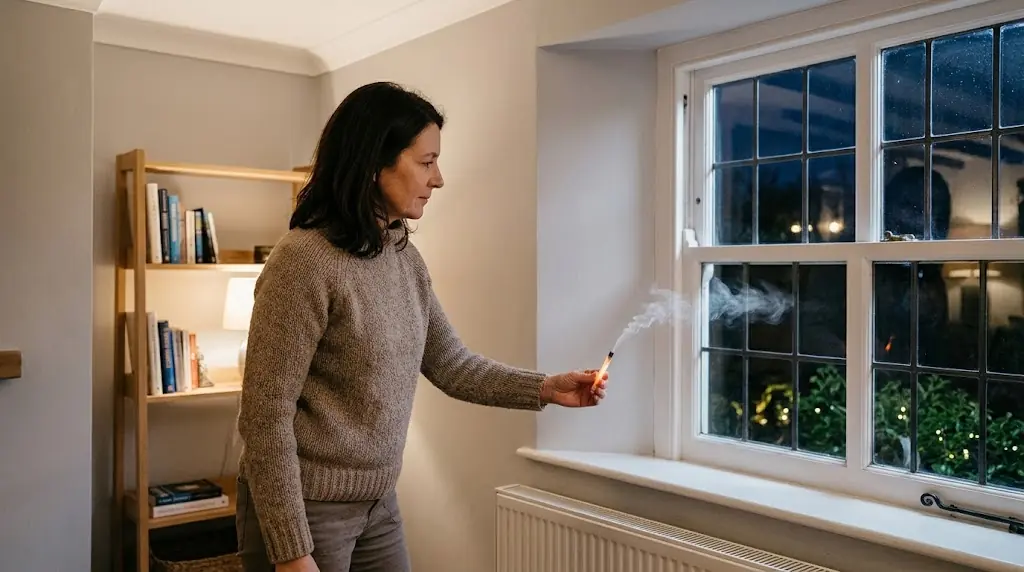
Quick answer: the simplest way to find a cold draught is to wait until the heating has been on for half an hour on a cold, ideally windy day, then move the back of a hand slowly along likely gaps and watch the smoke from a stick of incense or a smoke pen. Smoke that bends, streams or gets pulled toward a gap marks a draught. A thermal camera or infrared thermometer helps confirm the cold areas, and a professional air tightness test measures the whole house. No home draught detector is essential, and most draughts are found with free or very cheap methods.
Hidden draughts are one of the most common reasons UK homes feel colder than they should, even when the heating is working properly. They are not always the obvious breeze near a badly fitting window. Small gaps and air paths quietly pull warm air out of the house all day, lowering room temperatures and making the boiler run longer. If it is not clear whether cold rooms come from draughts, missing insulation or a heating flow problem, the free house cold diagnostic on WarmGuide helps narrow it down before the search starts.
What is a cold draught and why does it matter?
A cold draught is a flow of outside air, or air from an unheated space, coming into a room through a gap. Warm indoor air leaves through other gaps higher up, which pulls more cold air in at the bottom. This is why draughts are often felt around ankles and feet, even when the room air reads a comfortable temperature.
Cold draughts matter for three reasons. They make rooms feel colder than the thermostat says, they force the heating to work harder to compensate, and they can push the boiler to run for longer without the room ever feeling properly warm. Draughts are also easy to overlook, because many do not feel like a breeze. They feel like a narrow strip of cooler air.
Why hidden draughts are harder to find than obvious ones
The draughts most people notice first are around doors and windows, where a worn seal or badly fitting frame lets in a detectable flow of cold air. These are worth fixing, but they are rarely the whole picture. The bigger losses often come from gaps that are out of sight or not obviously linked to heat loss:
- The floor void beneath suspended timber boards
- The gap around a pipe where it enters a wall or floor
- The back of an electrical socket on an external wall
- The edge of a loft hatch that does not sit flush
- Gaps behind skirting boards and under stairs
- Unused chimneys, letterboxes and keyholes
These work against a home in two ways. Cold air comes in through them from outside or from unheated voids, and warm air escapes through them continuously while the heating is running.
Drafts in houses: how to detect them step by step
Finding draughts takes about an hour for an average home, and the method matters more than the equipment. The steps below work in any UK house.
- Pick the right conditions. A cold day with the heating running for at least thirty minutes gives the biggest temperature difference between inside and outside, which makes air movement easier to detect. Windy days help too, because wind pressure pushes air through gaps.
- Close everything. Shut windows, doors and loft hatches, and turn off extractor fans and cooker hoods, which pull air through the house and confuse the results.
- Work one room at a time, starting at floor level. Most air infiltration happens low down, then work upward.
- Check surfaces next to external walls, unheated voids and cold areas such as garages, porches and unheated hallways.
- Mark each leak with a small piece of masking tape so it can be fixed later, then move on.
Using your hand as a draught detector
No specialist equipment is needed to find most hidden draughts. Hold a hand a few centimetres from the surface rather than pressing it flat, and move slowly enough that brief temperature changes register. A wet hand is more sensitive, because evaporation makes even a slight air movement feel cool.
Work along window frames, skirting boards, internal door frames, the edges of floorboards, pipe entry points and the space behind radiators. Many hidden draughts feel like a narrow strip of cooler air against the back of the hand. That is easy to dismiss on a first pass, but it becomes obvious when the same cold band turns up in the same place on a second pass.
Using smoke or a candle flame to see airflow
For more sensitivity, a lit candle or lighter flame responds to air movement that is too subtle for the hand. Hold the flame slowly along joints and edges while keeping the room as still as possible. In still air the flame burns steadily, and any flicker or lean toward a surface shows air movement at that point.
A stick of incense or a smoke pen is a safer option, because it has no open flame and the smoke makes the airflow visible. Smoke that streams out of a gap shows air leaving the house, and smoke that gets pulled toward a gap shows cold air coming in. This works particularly well around loft hatch edges, pipe cut-outs through walls and floors, cable holes, stair voids and behind skirting boards, where a gap is too narrow to feel by hand.
Keep any flame well away from curtains, paper and other flammable material, and never use a naked flame near a gas appliance or where gas could be present. If there is any smell of gas, stop, leave the property and call the National Gas Emergency number.
Do you need a home draught detector?
A home draught detector is not essential, but a few tools make the job faster or confirm what the hand and smoke have found:
- Smoke pen or incense stick: the best value draught finder for small gaps, because it shows the direction of airflow.
- Infrared thermometer: gives a surface temperature reading, so a cold patch around a socket, window frame or skirting stands out against the surrounding wall.
- Thermal imaging camera: shows cold areas as a picture. It detects surface temperature rather than airflow itself, so it works best when there is a large temperature difference between inside and outside, and it should be read together with a smoke test.
- Anemometer: measures air speed at a gap, though it is rarely necessary at home.
- Professional air tightness test: a fan fitted in the front door pulls the whole house to a set pressure while a surveyor traces leaks. It is the most accurate whole-house test and is usually only worth it for a major retrofit or a very leaky home.
For most homes, a candle or smoke source and a free hand do the job, with a thermal camera or infrared thermometer as a useful extra.
Floor voids and suspended timber floors
In older UK homes with suspended timber floors, cold air from the sub-floor void can enter the room through gaps between floorboards, at the junction between boards and skirting, and through poorly sealed service pipes. Carpet, laminate and vinyl hide this almost completely, because the floor surface feels cool rather than cold and the air movement happens beneath the covering.
The most reliable check is to run a hand along the base of the skirting board once the heating has been on for a while. A consistent narrow cold line at floor level, particularly along external walls, almost always means air is rising from the void below. Cold floors in winter covers the specific causes and fixes for floor-level heat loss in more detail.
Pipe entry points through walls and floors
Wherever a pipe enters a wall or floor, there is usually a gap around it. Sealant applied during installation dries out, cracks and shrinks over time, and in many older properties the gap was never sealed properly in the first place. Pipes often pass through external walls or unheated floor voids, so these openings create a direct link between the room and cold air outside.
Check around radiator pipes at floor level, the pipe entries behind kitchen appliances, the waste pipe beneath sinks and wherever the boiler flue or gas supply goes through a wall. A smoke test near each one shows which are actively letting air in. Flexible sealant or pre-formed pipe collars close these gaps quickly and cheaply. Do not seal around a boiler flue itself, and leave that to a Gas Safe registered engineer.
Electrical fittings on external walls
Plug sockets and light switches on external walls are a frequently overlooked source of cold air. The back box sits within the wall cavity, and if the cavity is exposed behind it, cold air from outside can travel through the fitting into the room. The gap is small, but the effect is measurable, particularly on walls that face the prevailing wind.
Foam gaskets fitted behind the socket or switch faceplate close the air path without interfering with the wiring. Isolate the circuit at the consumer unit before removing any faceplate, or use an electrician. Cold air coming through plug sockets explains the mechanism and the fix in more detail.
Loft hatches and the upward escape of warm air
Warm air rises, and a poorly sealed loft hatch lets it drift continuously into the loft space above. Many hatches are thin, uninsulated, or do not sit flush against the frame, leaving a gap around the edge that is difficult to see but easy to feel. The hatch is often the single largest hidden draught in a two-storey home, because it combines the buoyancy of warm air with a direct opening into an unheated space.
Running a hand along the hatch edges once the heating has been on for thirty minutes usually reveals the heat loss even when the gap is not visible. Draught-proofing strip around the frame and an insulated board on top of the hatch fix both the air leakage and the heat conducted through the hatch itself. Cold air from the loft hatch covers the full range of fixes.
Letterboxes, keyholes and unused chimneys
Letterboxes are among the easiest draughts to find, because the flap or the gap around it lets air pass freely. A brush strip or a letterbox cover cuts most of that flow, and the problem is covered in heat loss through the letterbox. Old keyholes can be fitted with a simple cover. An unused chimney is a large opening to the outside, and it should be sealed with a ventilated cap or a chimney balloon, which keeps the necessary ventilation while stopping the downdraught. A blocked flue on a working fire or boiler is dangerous, so never block a chimney that serves an appliance.
Internal draughts from colder parts of the house
Not all draughts originate outside. Cold hallways, stairwells, unheated utility rooms and poorly heated bathrooms can send cooler air into warmer rooms through gaps at the base of internal doors and around door frames. This internal airflow feels like an outside draught even though its source is another part of the house.
Where a hallway or stairwell stays cold, it acts as a reservoir of cool air that feeds every room that opens onto it. Draught-proofing the internal doors between the hallway and the heated rooms reduces this transfer. Why hallways are often the coldest part of a UK home, and what to do about it, is covered in why hallways are always freezing, and the same effect can explain heating that works upstairs but not downstairs.
Ventilation grilles, airbricks and why not to seal everything
Some openings are there on purpose. Airbricks ventilate a suspended floor void and must not be blocked, because they prevent damp and rot in the floor structure. Extractor fans, trickle vents and the air supply to open-flue appliances such as gas fires and some boilers also need to stay open, and blocking them can cause condensation, mould or, with fuel-burning appliances, carbon monoxide risks.
The aim of draught-proofing is to close unintended gaps while keeping controlled ventilation. If condensation or mould appears after a round of sealing, the guide to damp versus condensation explains how to tell the causes apart. Adjustable grilles let airflow be controlled by season without closing the opening permanently.
Is it a draught or cold walls?
A room can feel cold because of air moving through gaps, or because cold surfaces are pulling heat out of the room by radiation. The two are easy to confuse, and they need different fixes. The quick check is that a draught is felt as moving air and shows up in a smoke test, while a cold wall or window feels cold to the touch without any air movement. Cold surfaces are covered in why walls feel cold to the touch, and rooms that stay cold whatever the cause are covered in why one room never warms up. If a radiator is the problem rather than the room, radiator not getting hot is the next stop.
What changes once cold draughts are sealed
Sealing hidden draughts often makes a more noticeable difference to comfort than adjusting thermostat settings or reprogramming the heating. Rooms hold heat longer after the heating turns off, radiators cycle less during the heating period, and the cold bands at floor level and around fittings largely disappear. If the boiler is running but the house still feels cold afterwards, boiler running but house still cold covers the other possible causes.
The products that work best for each type of draught, and the ones that are less effective than the marketing suggests, are covered in the best draught stoppers for UK homes. To get a sense of what unaddressed draughts may be adding to yearly fuel bills, the WarmGuide heating cost calculator gives a baseline estimate, and the Price of a Warm Home index shows how heating costs compare across 29 UK cities.
Draught-proofing fits into the wider picture of cutting heat loss across the whole building. How it connects to insulation, heating controls and the order in which improvements deliver the best return is covered in the complete guide to keeping a UK home warm for cheap, and grants that may help with the bigger jobs are listed in the energy grants guide and the Warm Homes Local Grant guide.
Draught finder FAQ
How do I find a cold draught in my house?
Wait until the heating has been on for thirty minutes on a cold day, close all windows and doors, then move the back of a hand slowly along window frames, skirting boards, pipe entries and fittings. Confirm what is found with a smoke pen, incense stick or candle held near the gap, since smoke that bends or streams marks the air path.
What is a draught detector?
A draught detector is any tool that shows where air is moving through gaps. The most useful are a smoke pen or incense stick, an infrared thermometer and a thermal imaging camera. A thermal camera shows cold surfaces rather than air itself, so it is best used alongside a smoke test.
Can you buy a home draught detector?
Yes. Smoke pens, infrared thermometers and thermal cameras (including phone attachments) are sold online and in hardware shops. They help, but they are not essential, because a hand and a smoke source find most draughts for free.
Where are the most common draughts in a UK home?
Windows and external doors, letterboxes, keyholes, skirting boards and floorboards over a suspended floor, loft hatches, pipe entries, sockets on external walls and unused chimneys. Cold hallways and stairwells can also send cool air into warm rooms.
Why do I feel a cold draught with the windows closed?
Air can come in through floors, skirting, sockets, pipe gaps, the loft hatch or an unused chimney, or can travel from a colder part of the house. A cold window or wall surface can also feel like a draught even with no air moving, because it pulls heat away from the body.
Is it safe to use a candle to find draughts?
It is safe if care is taken. Keep the flame away from curtains and paper, work slowly, and never use it near gas appliances or if there is any smell of gas. An incense stick or smoke pen is a safer alternative that shows airflow without an open flame.
Can I seal every draught in my house?
No. Airbricks, extractor fans, trickle vents and the air supply to open-flue appliances must stay open. Sealing everything can cause condensation and mould, and with some fuel-burning appliances it creates a carbon monoxide risk. Seal unintended gaps and keep controlled ventilation.
Does draught-proofing make a noticeable difference?
It often does. Rooms hold heat longer, radiators cycle less and cold bands at floor level disappear. It is also one of the cheapest improvements to a home and works well alongside insulation.
Do I need a professional air tightness test?
Usually not. A professional test is mainly useful for a major renovation, a new build or a very leaky home where the draughts cannot be found with a simple search. For most homes, a room-by-room check with a hand and a smoke source is enough.
Where to go from here
Start with the room that feels coldest, work from floor level upward, and mark each gap before fixing it. For a full picture of why the home is cold, run the cold home diagnostic or browse WarmGuide for guides on boilers, radiators, walls and grants.