Awaab’s Law for Landlords – A Year On
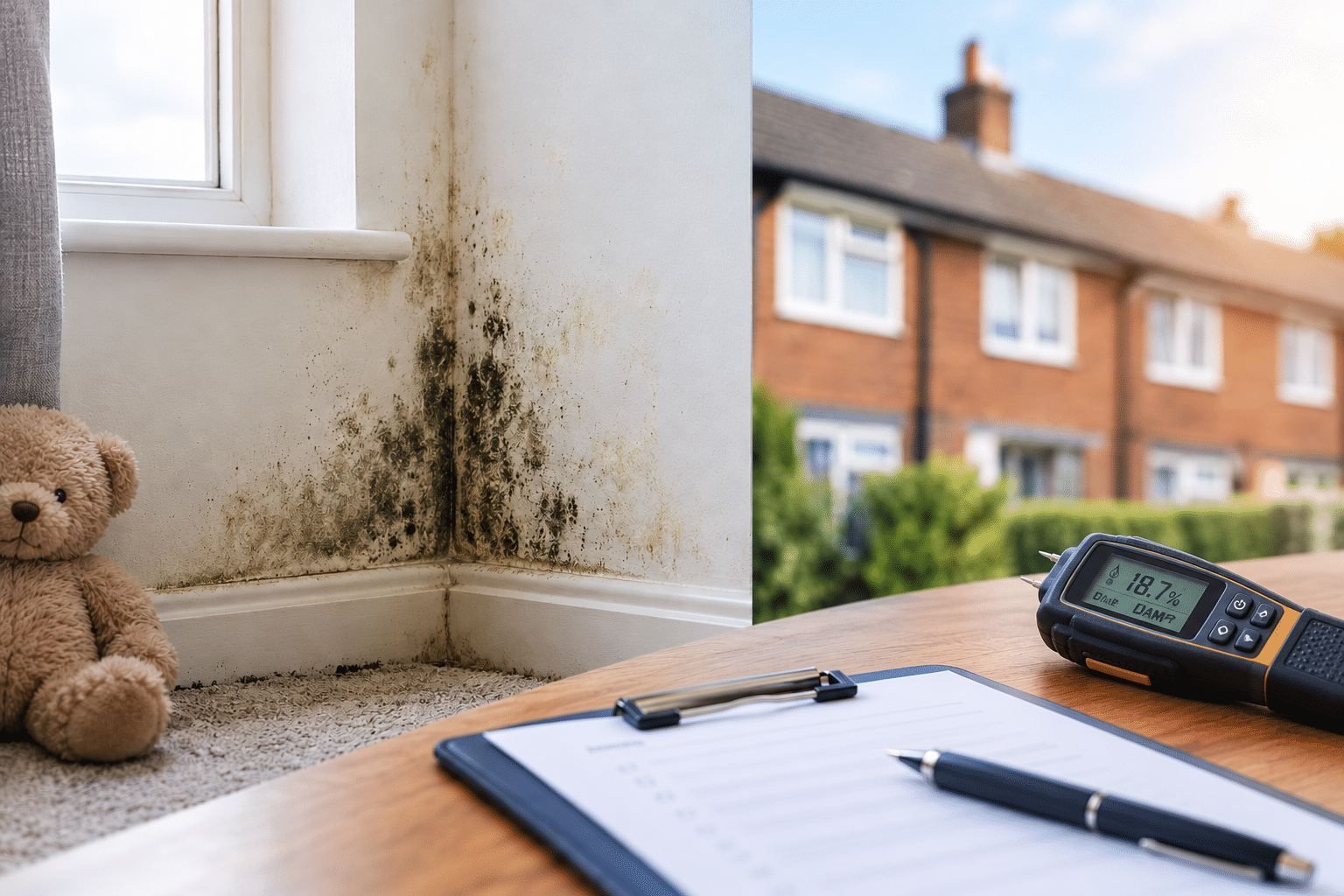
Awaab’s Law has applied to social landlords in England (councils and housing associations) since 27 October 2025, covering emergency hazards and significant damp and mould. Phase 2 starts on 30 November 2026 and adds excess cold, excess heat and five other hazard types. Private landlords are not covered yet, but the Decent Homes Standard is due to apply to the private rented sector from 2035, and a minimum EPC rating of C is due from 1 October 2030.
Last updated 22 October 2026.
Awaab’s Law is now a year old, and the next stage lands in the middle of the heating season. From 30 November 2026, a cold home caused by a faulty heating system, poor insulation or draughts can trigger the same fixed legal deadlines that already apply to mould. That makes Awaab’s Law a heating issue as much as a damp issue, which is why landlords and housing associations need to look at how repairs, boilers and radiators are handled before winter.
This guide covers what Awaab’s Law requires, the timescales, what changes in Phase 2, who is and is not covered, and the practical steps landlords can take now.
What is Awaab’s Law?
Awaab’s Law is named after Awaab Ishak, a two-year-old who died in December 2020 after prolonged exposure to mould in a housing association flat in Rochdale. The coroner’s findings in 2022 led to new legal duties on social landlords to deal with serious hazards in fixed timeframes.
The rules sit under the Social Housing (Regulation) Act 2023 and are set out in the Hazards in Social Housing (Prescribed Requirements) (England) Regulations 2025. They apply to social landlords in England: local authorities and housing associations. Scotland, Wales and Northern Ireland have their own separate rules.
The law does not cover every defect. It applies to hazards that pose a significant risk of harm to the health or safety of the people living in the home, and to emergency hazards that need immediate action.
Awaab’s Law timeline: phases and dates
| Stage | Date | What it covers |
|---|---|---|
| Phase 1 | 27 October 2025 | All emergency hazards and significant damp and mould hazards |
| Phase 2 | 30 November 2026 | Excess cold, excess heat, falls, structural collapse and falling elements, fire and explosions, electrical hazards, and domestic hygiene including pests |
| Phase 3 | 2027 | All remaining significant hazards except overcrowding |
Some guidance published earlier in 2026 gave 27 October 2026 as the Phase 2 date. The government has since confirmed 30 November 2026 for the amending regulations and has published Phase 2 guidance for social landlords on GOV.UK.
Awaab’s Law timescales: how fast do landlords have to act?
For significant hazards, such as dangerous damp and mould (and, from 30 November 2026, the Phase 2 hazards), the government has set out this sequence:
- Investigate within 10 working days of becoming aware of the hazard.
- Give the tenant a written summary within 3 working days of the investigation, setting out what was found and what will be done.
- Carry out urgent safety work within 5 working days of the investigation, which means a home should be made safe within 15 days or less of the report, as the government puts it.
- Start longer-term repairs within 12 weeks.
For emergency hazards, the landlord must act as soon as possible and within 24 hours. If an emergency hazard cannot be fixed in time, the landlord must provide alternative accommodation.
The requirements are implied into social tenancy agreements, so a tenant can take legal action for breach. Landlords also face scrutiny from the Housing Ombudsman and the Regulator of Social Housing.
What changes on 30 November 2026: excess cold and excess heat
Excess cold is the Phase 2 hazard most closely tied to home heating. It is one of the most common serious hazards found in social housing stock, and it is linked to respiratory illness and heart problems, particularly in older people and young children.
The government’s Phase 2 guidance makes clear that a home with inadequate heating, poor insulation or a defective heating system can fall within scope where it presents a significant risk to the people living there. Disrepair, such as a broken window or door that lets cold air in, can also lead to an excess cold hazard.
The law does not use a single trigger temperature. The test is whether there is a significant risk of harm. As a general reference point, health guidance commonly cites around 18°C as a healthy minimum for living rooms and bedrooms, and there is no single legal minimum temperature for rented homes in England.
In practical terms, a tenant reporting no heating in winter, a boiler that keeps failing, radiators that will not warm up, or rooms that cannot be heated is raising an issue that could now start the Awaab’s Law clock.
Why damp and mould is also a heating problem
Most damp and mould in occupied homes is caused by condensation rather than leaks or rising damp. Warm, moist air from cooking, washing and breathing meets cold surfaces and turns to water. Mould then grows on walls, window reveals, behind furniture and in corners.
That means the usual causes are a mix of low surface temperatures (poor insulation, cold bridging, draughts), heating that is inadequate or unaffordable to run, and poor ventilation. Fixing the heating and the building fabric is often what stops the mould coming back, rather than repeated cleaning or anti-mould paint.
Damp and mould should not be treated as a “lifestyle issue” by default. The Housing Ombudsman and government have been clear that where a tenant reports it, the landlord must listen and investigate. For a plain-English explanation of the difference between the two causes, see the difference between damp and condensation.
The problem is not limited to social housing. Citizens Advice figures reported by the lettings press suggest that nearly half of private rented homes still have damp and mould issues.
Common heating faults that can turn into Awaab’s Law cases
Many of the faults that start a hazard investigation are routine heating problems that are cheap to fix when caught early. These are the ones that come up most often:
- Radiators that stay cold. A radiator that will not heat can mean trapped air, a stuck valve or sludge. See radiator not getting hot and one radiator not working.
- Trapped air. Bleeding radiators is the first fix for cold tops and gurgling. See how to bleed a radiator step by step.
- Unbalanced systems. Rooms nearest the boiler overheat while the rest stay cold. See how to balance radiators properly.
- Heating that works upstairs but not downstairs. This is common in older systems and often points to flow or valve problems. See heating works upstairs but not downstairs.
- Boiler pressure problems. A boiler that drops pressure will lock out and leave a home without heating. See boiler losing pressure and boiler pressure drops overnight.
- Frozen condensate pipes. In cold snaps, a frozen condensate pipe is one of the most common reasons a condensing boiler shuts down. See frozen condensate pipe.
- Draughts and air leaks. Gaps around doors, windows, floors and loft hatches keep rooms cold and feed condensation. See how to find hidden draughts.
For a wider look at cheap ways to keep a property warm, the complete guide to keeping a UK home warm for cheap covers the full list.
What housing associations and social landlords should do before 30 November
- Update the repairs triage process. Reports of no heating, repeated boiler faults or cold rooms need to be logged, categorised and sent for inspection fast enough to meet the 10 working day and 3 working day windows. Many landlords built case management for damp and mould in Phase 1 and now need to extend it to excess cold and excess heat.
- Identify the homes most likely to generate cases. Properties with old or unreliable boilers, electric storage heating, solid walls without insulation, single glazing or known condensation problems are the ones most likely to trigger an excess cold investigation.
- Line up engineers and contractors. Excess cold cases need heating engineers and insulation or draught-proofing contractors who can attend inside the 5 working day window for urgent safety work.
- Service heating systems before winter. Boiler servicing, pressure checks, condensate pipe checks and radiator bleeding remove many of the faults that cause no-heat calls in the first place.
- Look at the building fabric, not just the repair. Repeat visits to the same property for cold or mould usually mean the cause has not been fixed. Draught-proofing, loft and wall insulation and ventilation upgrades reduce repeat cases.
- Give tenants clear heating and ventilation advice. Guidance should be practical and non-blaming: how to use controls, how to bleed a radiator, how to reduce condensation and who to contact. Tenants need to be able to report problems easily and to get a written response.
- Keep records. Dates of reports, investigations, summaries and works are the evidence a landlord will need if a case goes to the Ombudsman, the regulator or court.
Does Awaab’s Law apply to private landlords?
Not yet. Awaab’s Law currently covers social landlords in England only. The Renters’ Rights Act brings the Decent Homes Standard into the private rented sector for the first time, and the government has confirmed that the standard will apply in both the social and private rented sectors from 2035. The Decent Homes Standard includes damp and mould and excess cold within its hazards and requires homes to provide thermal comfort.
Private landlords still have existing duties under the Housing Health and Safety Rating System, which councils enforce, and complaints about damp, mould and cold can already lead to improvement notices and fines. Legal firms are also advertising mould claims against landlords more heavily than before, so waiting until 2035 to act carries real risk.
Private landlords can use the same approach as social landlords: investigate quickly, fix the cause, keep records and give tenants a written response.
EPC rules and Awaab’s Law: the overlap
Energy efficiency rules are moving in the same direction as hazard rules. Under the government’s January 2026 decisions, privately rented homes in England and Wales will need to meet the equivalent of EPC band C by 1 October 2030, with a cost cap of £10,000 before an exemption can be registered. Social landlords face an EPC C (or equivalent) target by 1 April 2030.
Homes that are insulated, draught-proofed and efficiently heated are less likely to generate cold and mould cases, so EPC upgrade work and hazard prevention largely overlap. The new EPC rules explained covers the changes to the certificate and whether to get one now or wait.
Funding and cost: grants and running costs
Insulation, heating upgrades and ventilation work cost money, and the right grant can cover part of it. WarmGuide’s energy grant checker shows which grants can be combined, and the Warm Homes Plan guide covers what is changing in 2027. Social landlords should also check the funding schemes aimed at social housing retrofit, as eligibility differs from owner-occupier grants.
For tenants, running costs matter just as much as repairs. A heating system that works but is too expensive to use leaves rooms cold and increases condensation. The heating cost calculator shows what typical heating costs are at current price cap rates, and the Price of a Warm Home Index compares costs across UK cities and neighbourhoods. More guides are on the WarmGuide homepage.
Awaab’s Law frequently asked questions
What is Awaab’s Law?
Awaab’s Law is a set of legal duties on social landlords in England to investigate and fix serious housing hazards within fixed timeframes. It is named after two-year-old Awaab Ishak, who died in 2020 after exposure to mould in a housing association flat. It applies to councils and housing associations.
When did Awaab’s Law come into force?
Phase 1 came into force on 27 October 2025 for social landlords in England. It covers all emergency hazards and significant damp and mould hazards.
When does Awaab’s Law Phase 2 start?
Phase 2 starts on 30 November 2026. It adds excess cold, excess heat, falls, structural collapse and falling elements, fire and explosions, electrical hazards, and domestic hygiene including pests, where they pose a significant risk of harm.
What are the Awaab’s Law timescales?
For significant hazards, landlords must investigate within 10 working days, give the tenant a written summary within 3 working days of the investigation, carry out urgent safety work within 5 working days of the investigation and start longer-term repairs within 12 weeks. Emergency hazards must be dealt with as soon as possible and within 24 hours.
Does Awaab’s Law apply to private landlords?
Not currently. It covers social landlords in England only. The Decent Homes Standard, which includes damp, mould and excess cold, is due to apply to the private rented sector from 2035, and private landlords already have duties under the Housing Health and Safety Rating System.
Does Awaab’s Law cover a broken boiler or no heating?
From 30 November 2026, a broken or defective heating system can fall within Awaab’s Law where it creates a significant risk of harm from excess cold. A breakdown is not automatically in scope in every case, because the test is the level of risk to the people living in the home, but a home without heating in winter, particularly with young children or older or unwell residents, is likely to need urgent action.
Is mould the tenant’s fault?
Landlords should not assume it is. Damp and mould are not treated as lifestyle issues, and the cause is often a mix of cold surfaces, inadequate heating and poor ventilation. The landlord has to investigate when it is reported.
Is there a legal minimum temperature for a rented home?
There is no single legal minimum temperature for rented homes in England. Excess cold is assessed on whether there is a significant risk of harm. Health guidance commonly cites around 18°C as a healthy minimum for living rooms and bedrooms.
What is the Decent Homes Standard?
The Decent Homes Standard sets minimum expectations for the condition of rented homes, including freedom from serious hazards and the provision of thermal comfort. It has applied to social housing for years, and the government has confirmed it will apply to both social and private rented homes from 2035.
What should a tenant do if damp, mould or cold is reported and nothing happens?
Report the problem in writing and keep a copy. Social tenants can use the landlord’s complaints procedure and then escalate to the Housing Ombudsman. Private tenants can contact the local council’s environmental health team, which can inspect and enforce.
Does Awaab’s Law apply in Scotland, Wales and Northern Ireland?
No. Awaab’s Law applies to social housing in England. Scotland, Wales and Northern Ireland have separate laws and are consulting on their own approaches to damp and mould.
What do landlords need to do before the winter?
Service heating systems, check boiler pressure and condensate pipes, bleed and balance radiators, deal with draughts, review the repairs triage process for cold and no-heat reports, and keep records of every report and response. Planning ahead reduces both the number of cases and the cost of resolving them.