Autumn Budget 2026 and Energy Bills: What Changes for UK Households
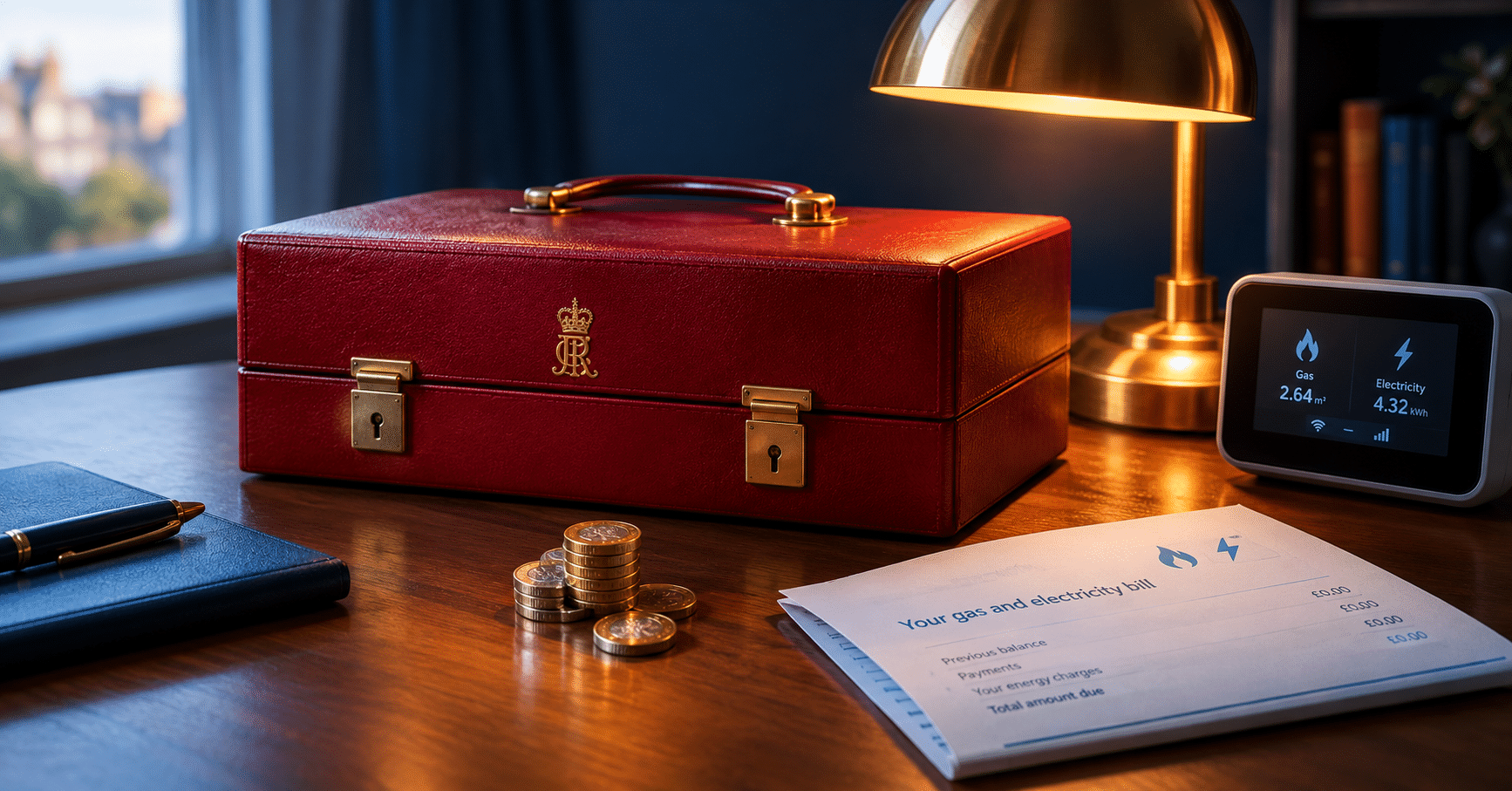
Published 28 October 2026, the day of the Budget. This page is updated as the detail is confirmed.
Quick answer: The Autumn Budget did not cut the energy price cap, but it brought three direct bill measures. Homes in council tax bands A to D in England get a one-off £100 Household Energy Payment from January 2027. The 0% VAT rate on household electricity is extended to 30 June 2027. Gas standing charges are to be scrapped from 2027, or as soon as possible after. The price cap itself is set by Ofgem: it is £1,723 for a typical household until 31 December 2026, and the January to March 2027 cap is forecast to rise.
Quick Check: Are You Eligible?
Autumn Budget 2026 energy measures at a glance
Chancellor John Healey delivered the Budget on Wednesday 28 October 2026. Here is every measure that affects household energy bills, and when it starts.
| Measure | What changes | Who it affects | When |
|---|---|---|---|
| Household Energy Payment | £100 one-off payment | Homes in council tax bands A to D in England (up to 20 million) | From January 2027 |
| VAT on household electricity | Stays at 0% instead of returning to 5% | All household electricity in Great Britain, including fixed tariffs | Extended to 30 June 2027 |
| Gas standing charges | Scrapped, with the cost moved onto the price per unit of gas | Gas customers in Great Britain | 2027, or as soon as possible after |
| Electricity standing charges | Reform promised, no date | Electricity customers | Details due later |
| New policy costs on bills | None added until a new cost control framework is set | All bill payers | Until the 2027 spending review |
| Gas Shipper Obligation | Planned hydrogen levy on gas bills scrapped | Gas customers | Announced 28 October |
| Kerosene heating oil tariffs | Import tariffs suspended | Homes heated with oil | 26 November 2026 to 31 December 2028 |
| Energy debt | One-off debt relief scheme for eligible households | Households in energy debt | Launching next year |
Has the Budget lowered the energy price cap?
No. The energy price cap is set by the regulator, Ofgem, every three months, and the Budget does not change that process. What the Budget changes is the tax and policy costs that feed into it, plus separate payments from government.
The cap currently in force covers 1 October to 31 December 2026. Ofgem set it at £1,723 a year for a typical household paying by Direct Debit, up 4% (about £60) on the £1,663 cap that applied from July. That figure already includes the removal of VAT from electricity, which started on 1 October. Our guide to what the energy price cap is and how it works explains the mechanics in full.
| Price cap rates (Direct Debit) | Electricity | Gas |
|---|---|---|
| Unit rate, October to December 2026 | 26.32p per kWh | 7.97p per kWh |
| Standing charge, October to December 2026 | 54.83p per day | 29.68p per day |
A “typical household” under Ofgem’s current definition uses 2,500 kWh of electricity and 9,500 kWh of gas a year. Ofgem updated this benchmark in 2026, so older articles quote higher headline figures for the same cap level. Real bills depend on actual use and region, not the headline number.
What will the price cap be in January 2027?
Ofgem announces the January to March 2027 cap by 25 November 2026. Until then, only forecasts exist, and they point upwards because wholesale gas prices have stayed high during the Middle East conflict.
- Cornwall Insight (30 September 2026): £1,999 a year, up 16% or £276 on October. It said a January rise was “all but certain” because September’s wholesale price rises were already locked into the measurement window.
- Supplier forecasts published in October: roughly £2,065 to £2,185 a year, depending on the supplier.
| Rate | October to December 2026 (confirmed) | January to March 2027 (Cornwall Insight forecast) |
|---|---|---|
| Electricity unit rate | 26.32p per kWh | About 30.3p per kWh |
| Electricity standing charge | 54.83p per day | About 55p per day |
| Gas unit rate | 7.97p per kWh | About 9.8p per kWh |
| Gas standing charge | 29.68p per day | About 31p per day |
| Typical annual bill | £1,723 | About £1,999 |
The January figure is a forecast, not a price. The Budget measures do not change it much: the electricity VAT cut is already built in, and the standing charge change comes later. The longer VAT extension mainly matters for the April 2027 cap, where the Treasury expects it to take around £50 off the annual figure. For the impact of the conflict on bills, see Iran war and UK energy bills, and to see what a forecast rise means for your own home, use the heating cost calculator.
£100 Household Energy Payment: who gets it and when
The Household Energy Payment is a £2.6 billion scheme giving £100 to up to 20 million households this winter. It is the only direct payment towards bills in the Budget.
| Question | Answer |
|---|---|
| How much? | £100, one-off |
| Who qualifies? | Households in England in council tax bands A to D |
| When? | From January 2027 |
| Do you need to apply? | Not as announced. Payment is expected to be made automatically, with councils involved in delivery |
| Bands E to H? | Not eligible automatically. Councils in England get an extra £100 million to help struggling households, including some in higher bands |
| Scotland, Wales and Northern Ireland? | Their governments receive funding through the Barnett formula and will announce their own support |
To check your band, use the council tax band checker on GOV.UK. Beware of texts, emails or calls telling you to “claim” the payment through a link. A genuine payment will be arranged through your council’s own website and systems, so check there from January. The payment sits alongside other help, such as the Warm Home Discount; see energy grants and support for UK homes for what else is available.
Gas standing charges to be scrapped
The government has asked Ofgem to remove the standing charge from household gas bills. The same money would instead be recovered through a higher price per kWh of gas. The Treasury’s target is 2027 or as soon as possible after, and it is unlikely to arrive in time for this winter.
The standing charge is a fixed daily fee paid whether or not any gas is used. Under the current cap it is 29.68p a day, roughly £108 a year. The government estimates that around 60% of households with a gas account would save about £45 a year on average. The other 40% would not save, and some would pay more. Energy consultancy Cornwall Insight pointed out that people in poorly insulated homes, larger families and those who need the heating on for health reasons could be among those paying more, which is why the details of any protection matter.
Who gains and who loses: an illustration
The table below is an illustration only. It assumes the roughly £108 gas standing charge is spread evenly over each unit of gas, using an average national gas use of about 11,200 kWh a year. Ofgem will decide the real design, so the figures will differ.
| Annual gas use | Standing charge removed | Extra cost on unit rate (about 0.97p per kWh) | Illustrative change |
|---|---|---|---|
| 5,000 kWh (small flat, low use) | -£108 | +£48 | About £60 better off |
| 8,000 kWh | -£108 | +£77 | About £31 better off |
| 9,500 kWh (Ofgem typical) | -£108 | +£92 | About £16 better off |
| 11,200 kWh (national average) | -£108 | +£108 | No change |
| 14,000 kWh | -£108 | +£135 | About £27 worse off |
| 18,000 kWh (large, draughty home) | -£108 | +£174 | About £66 worse off |
The pattern is what matters: low gas users gain, high gas users pay more, and cutting the amount of gas used becomes worth more per kWh saved. That makes insulation and draught-proofing more valuable. Our guides on keeping a UK home warm cheaply and the Price of a Warm Home Index show where heating costs are highest.
Electricity standing charges stay for now. The Chancellor said similar reform would follow for electricity, but it was described as more complicated and slower. The current electricity standing charge is 54.83p a day, about £200 a year.
VAT on electricity stays at 0% until 30 June 2027
VAT on household electricity fell from 5% to 0% on 1 October 2026, initially until the end of March 2027. The Budget extends the 0% rate by three months to 30 June 2027, with the 5% rate returning on 1 July 2027.
- It applies to all household electricity in Great Britain, including customers on fixed tariffs.
- Gas still carries 5% VAT. There was no VAT cut on gas, heating oil or LPG.
- The Treasury expects the extension to take about £50 off the annual price cap from April 2027.
- Northern Ireland is reported to be getting equivalent relief from April 2027.
No new policy costs on bills, and the hydrogen levy dropped
Policy costs are the government-backed charges built into bills, such as the cost of supporting renewables. The Budget says no new policy costs will be added to bills until a new cost control framework is set at the 2027 spending review, unless a cost lowers bills or is essential for security of supply. The planned Gas Shipper Obligation, a levy intended to pay for hydrogen projects, has been scrapped, with those projects to be funded from public money instead.
This builds on the 2025 Budget, which removed the Energy Company Obligation from bills and moved 75% of the cost of the older Renewables Obligation onto general taxation from April 2026.
Where the money comes from
The Chancellor said energy bill support is partly paid for by a time-limited 3 percentage point increase in the banking surcharge, due to start in January and last 15 months. He also confirmed income tax, National Insurance and VAT rates were not raised. Taxes on income from property and savings go up by a further 2 percentage points from April 2027, which affects landlords: the property basic rate becomes 24%, the higher rate 44% and the additional rate 49%.
Heating oil, LPG and off-gas-grid homes
Import tariffs on kerosene heating oil are suspended from 26 November 2026 until 31 December 2028. The Budget did not publish an estimate of how much this will save a household, and heating oil prices still depend mainly on global markets. The coverage reviewed for this article mentions kerosene only, not LPG. For the wider picture, see how the Iran conflict affects heating oil and LPG households.
Help with energy debt
The government and Ofgem published a strategy on domestic energy debt that includes a one-off debt relief scheme for eligible households, due to launch next year. Eligibility rules had not been set out in the coverage available on Budget day. Anyone struggling now should contact their supplier, which must offer support such as repayment plans.
Insulation, heat pumps and grants after the Budget
Help for bills is more generous than help for upgrades. Based on the Budget documents as summarised by independent analysts, the main changes for home improvements are:
| Item | What the Budget means |
|---|---|
| VAT on insulation, heat pumps, solar panels and batteries | The temporary 0% rate ends on 31 March 2027 as planned and returns to 5% from 1 April 2027. Heat batteries join the 5% list |
| Boiler Upgrade Scheme grant | Grant levels unchanged at £7,500 for a heat pump, or £9,000 for off-gas-grid homes until 31 March 2027 |
| Boiler Upgrade Scheme budget | £400 million for 2027-28, compared with £600 million planned earlier |
| Warm Homes Plan | £1 billion of capital grant funding saved. The Treasury says most funding for low-income households and social housing is protected |
| ECO4 | Still closes on 31 December 2026, with no replacement scheme announced |
In practice, anyone planning insulation or a heat pump has a reason to ask installers whether the work can be completed before 31 March 2027, while VAT is still 0%. Grants are first come, first served until each year’s budget runs out. For the grant landscape, see the Warm Homes Plan explained, and use the energy grant checker to see which grants can be combined. Landlords should note that rented-home EPC rules were not changed; see the new EPC rules for 2027.
Why the Budget focused on energy
The Office for Budget Responsibility says higher energy prices linked to the Iran war are pushing up inflation. It forecasts inflation averaging 3.5% in 2027 and returning to 2% only in 2028, and expects real household disposable income per person to dip slightly in 2026 and 2027. The Chancellor reduced his fiscal headroom to £15 billion, partly because of the cost of responding to the conflict. That is why the package concentrates on bills rather than large new spending.
Key dates for energy customers
| Date | What happens |
|---|---|
| By 25 November 2026 | Ofgem announces the January to March 2027 price cap |
| 26 November 2026 | Kerosene heating oil import tariffs suspended |
| 31 December 2026 | ECO4 closes |
| 1 January 2027 | New price cap period begins |
| January 2027 | £100 Household Energy Payment begins (England, bands A to D) |
| 31 March 2027 | 0% VAT on insulation, heat pumps and solar ends; £9,000 off-gas heat pump grant ends |
| 1 April 2027 | 5% VAT on energy-saving materials; new price cap period begins |
| 30 June 2027 | Last day of 0% VAT on household electricity |
| 1 July 2027 | 5% VAT on household electricity returns, unless extended again |
| 2027 or later | Gas standing charges scrapped (government target) |
What households can do now
- Check your council tax band if you live in England. Bands A to D receive the £100 from January.
- Take meter readings on 31 December so the old and new price cap rates are applied correctly, especially if you do not have a smart meter.
- Look at fixed tariffs before the January cap is announced if you want certainty. A fix only beats the cap if it ends up below it, so compare unit rates, standing charges and exit fees, not just the headline annual cost.
- Heavy gas users have the most to gain from reducing demand once the standing charge moves onto the unit rate. Start with draught-proofing and radiator balancing; see how to bleed a radiator.
- Planning insulation or a heat pump? Ask installers about completion before 31 March 2027.
- Heating oil users should expect a possible small saving from 26 November, but should not count on it.
Scotland, Wales and Northern Ireland
Energy bill rules such as the price cap and electricity VAT apply across Great Britain, but the £100 payment is an England scheme. Scotland, Wales and Northern Ireland receive funding through the Barnett formula and will decide how to deliver similar support. Northern Ireland has a separate energy market and is not covered by the Ofgem price cap.
Autumn Budget 2026 energy bills: frequently asked questions
What did the Autumn Budget 2026 announce for energy bills?
A £100 Household Energy Payment for council tax bands A to D in England from January 2027, 0% VAT on household electricity extended to 30 June 2027, plans to scrap gas standing charges from 2027 or as soon as possible after, no new policy costs on bills until a cost control framework is set, and the planned hydrogen levy on gas bills dropped.
Has the Budget lowered the energy price cap?
No. Ofgem sets the cap. It is £1,723 a year for a typical household from 1 October to 31 December 2026. The Budget changes taxes and policy costs that feed into future caps, but does not reduce the current one.
What will the energy price cap be in January 2027?
Ofgem confirms it by 25 November 2026. Forecasts published before the Budget range from £1,999 (Cornwall Insight) to around £2,185 (some suppliers) for a typical household. These are forecasts, not confirmed prices.
Who gets the £100 Household Energy Payment?
Households in England in council tax bands A to D, which is up to 20 million homes. Bands E to H are not covered automatically, although councils get an extra £100 million to help some struggling households in higher bands.
When is the £100 energy payment paid, and do I need to apply?
Payments start in January 2027. As announced, the payment is automatic and delivered with the help of councils, so there is no application. Ignore any text, email or call asking you to claim it through a link.
Are gas standing charges being scrapped, and when?
Yes, that is the plan. The government has asked Ofgem to remove gas standing charges and recover the cost through unit rates, with a target of 2027 or as soon as possible after. It is unlikely to help this winter.
Will scrapping the gas standing charge save me money?
It depends on how much gas you use. The government estimates 60% of households with gas could save around £45 a year on average. Lower-than-average gas users tend to gain, and higher-than-average users, such as large or poorly insulated homes, tend to pay more.
What happens to electricity standing charges?
They stay for now. The Chancellor said similar reform would follow for electricity, but it is more complicated and will take longer, with details due later.
How long will VAT on electricity stay at 0%?
Until 30 June 2027. The 5% rate returns on 1 July 2027 unless government extends it again. Gas still has 5% VAT.
Does the Budget help people who heat with oil or LPG?
Import tariffs on kerosene heating oil are suspended from 26 November 2026 to 31 December 2028, but no saving was estimated. The coverage reviewed does not mention LPG.
Did the Budget change heat pump grants or insulation help?
Grant amounts for the Boiler Upgrade Scheme did not change, but the 2027-28 budget is £400 million rather than the £600 million planned earlier, the 0% VAT rate on insulation, heat pumps and solar ends on 31 March 2027, and £1 billion of capital grant funding is saved from the Warm Homes Plan.
Should I fix my energy tariff after the Budget?
That is a personal decision. A fixed deal protects against the January cap change but not against anything the deal itself charges, and it only saves money if it ends up below the cap. Compare unit rates, standing charges and exit fees, and check what happens to your tariff if standing charges are scrapped. This site gives information, not financial advice.
Does the Budget affect Scotland, Wales and Northern Ireland?
The electricity VAT cut and the price cap apply across Great Britain. The £100 payment applies to England, with funding passed to the other nations to deliver similar support. Northern Ireland is expected to get equivalent VAT relief from April 2027.
What about business energy customers?
Separate measures were announced for business, including a British Industrial Competitiveness Scheme taking 25% off electricity bills for around 10,000 firms from April 2027. Households are not covered by it.
Sources
- HM Treasury: Budget 2026 document
- GOV.UK: Chancellor abolishes standing charges on gas bills
- Ofgem: energy price cap unit rates and standing charges
- Cornwall Insight: January 2027 price cap forecast
- House of Commons Library: Autumn Budget 2026 summary
Figures are correct as of 28 October 2026. Forecasts change daily and policy detail may be updated by the Treasury, Ofgem and DESNZ. Back to the WarmGuide homepage.