Frozen Condensate Pipe: How to Thaw It and Get Your Boiler Working Again
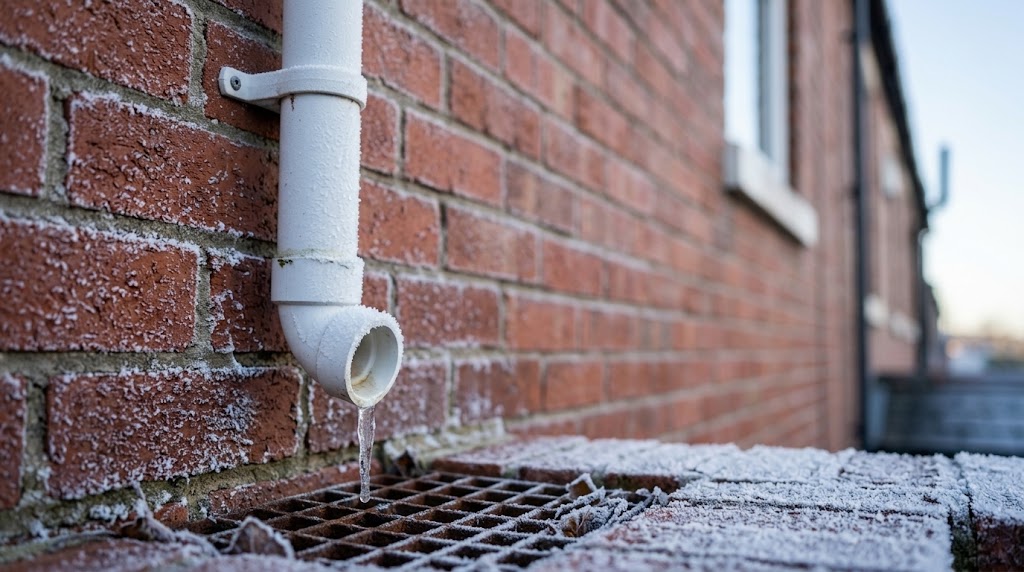
Frozen condensate pipe quick answer
A frozen condensate pipe is one of the most common reasons a condensing boiler stops working in freezing weather. Ice blocks the plastic pipe that carries waste water from the boiler to a drain, and the boiler shuts itself down to stop that water backing up inside it. To fix it, find the condensate pipe outside, pour warm (not boiling) water along the frozen section or hold a hot water bottle against it, then reset the boiler following the manual. If the boiler still will not restart, call a Gas Safe registered engineer.
Last updated 16 October 2026. Written for UK homes with a gas or oil condensing boiler.
It usually happens on the coldest night of the year. The heating worked yesterday, the temperature has dropped below freezing, and now there is no heating and no hot water, the boiler display is showing a fault code, and there may be a gurgling or bubbling noise coming from the boiler. That combination points strongly at a frozen condensate pipe, and the good news is that it is often a ten-minute fix you can do yourself without paying for a call-out.
This guide explains what a boiler condensate pipe is, how to tell if yours has frozen, the fault codes the main boiler brands show, how to thaw and unfreeze the pipe safely, what to do if that does not work, how to keep your home warm while the boiler is out, and how to stop the condensate pipe freezing again. It is part of WarmGuide’s home energy and heating advice, and the full boiler issues section covers the other common winter faults, so there are links throughout to the guides and tools that help with the rest of winter.
What is a boiler condensate pipe?
Every modern condensing boiler produces water as it burns fuel. A condensing boiler is designed to squeeze extra heat out of the exhaust gases, and as those gases cool the water vapour in them turns into liquid, called condensate. Since 2005 in England, almost every new gas boiler fitted has been a condensing model, so if your boiler is less than about twenty years old, it almost certainly has one. Condensing oil boilers have a condensate pipe too.
The condensate is mildly acidic, so it cannot simply drip out of the boiler. It collects in a small trap inside the boiler and drains away through a plastic condensate pipe, also called the condensate drain pipe, condensate waste pipe or condensation pipe. This pipe is usually white or grey, about the width of a finger or thumb, and it leaves the boiler and runs to a drain, a soil stack, a sink waste or an outside gully.
Condensate pipe or condensation: what is the difference?
The two words look alike but they are different problems. Condensate is the waste water a condensing boiler produces, and it drains away through the condensate pipe. Condensation is the moisture that forms on cold windows, walls and ceilings when warm, damp indoor air meets a cold surface. A frozen condensate pipe stops your boiler, while condensation leads to damp patches and mould. If you came here because of streaming windows or black spots on walls, the guides on the difference between damp and condensation and why mould forms in UK homes are the ones you need.
Why do condensate pipes freeze?
The condensate leaves the boiler as a small trickle of water, and when the pipe runs outside or through an unheated space such as a garage, that water can freeze in sub-zero weather. Once ice forms in the pipe, the water has nowhere to go, backs up into the boiler, and a safety device switches the boiler off before it can be damaged. This is why a frozen pipe usually causes a lockout rather than a leak.
Condensate pipes are most at risk of freezing when:
- the pipe runs outside the house, particularly on a north-facing or shaded wall
- the pipe has no insulation, or the insulation is damaged or not waterproof
- the pipe is narrow, which makes a blockage form faster
- the pipe has a long horizontal run, a dip or a sag where water can sit, rather than a steady downward fall
- the end of the pipe is exposed to wind, which makes the water at the outlet colder
- temperatures stay at or below 0°C for several hours or days, rather than dipping briefly
A pipe that has frozen once will tend to freeze again in the next cold snap unless something is changed, so the prevention section further down is worth reading even after the boiler is working again.
How to tell if your condensate pipe is frozen
Before you start pouring water on anything, check that a frozen condensate pipe really is the problem. The usual signs are:
- the boiler stopped working during or just after freezing weather, having worked normally before
- no heating and no hot water
- a fault code or warning light on the boiler display (see the list below)
- a gurgling, bubbling or glugging noise from the boiler or the condensate pipe
- a visibly frozen, cracked or ice-filled external pipe, or a pipe with no water dripping from the end
Some boilers also stop and restart repeatedly, trying to fire against the blockage, before they lock out for good. Not every boiler noise points to ice, though: if the boiler is running but simply louder than usual, see boiler makes loud noises when the heating comes on and why a boiler sounds louder when the heating is on. If the weather has been mild and the pipe is not outside, a frozen condensate pipe is less likely, and the fault is probably something else. In that case, check the house cold diagnostic if you are trying to work out why the house is cold, or move on to the section on when to call an engineer.
Frozen condensate pipe fault codes by boiler brand
Different boiler manufacturers show different codes when the condensate pipe freezes. These are the codes most commonly linked to a frozen condensate pipe:
- Worcester Bosch: EA, EA229 or D5. Some Worcester models also show a slow blue flashing light that stays off longer than it flashes.
- Vaillant: F28 or F29
- Baxi: E133 or E28
- Ideal: L2, F2, LF or FL, depending on the model. LF appears on older models such as the Isar and Mexico, and L2 and F2 on Logic boilers.
- Glow-worm: F28 or F29, and sometimes F1 or F4
These codes do not always mean a frozen pipe. Codes such as F28, F29, E133, L2 and F2 are also used for ignition failures, flame loss and gas supply faults. During freezing weather they are a strong clue, but the manual for your own boiler model has the definitive list. If the pipe is not frozen, or thawing it does not clear the code, treat it as a different fault and get it checked.
How to thaw a frozen condensate pipe
Thawing a frozen condensate pipe is safe and straightforward as long as you can reach the pipe from the ground. Do not climb a ladder or lean out of a window in icy conditions. If the pipe is out of reach, skip to the engineer section below.
- Confirm the pipe is frozen. Check the display for a fault code from the list above, and listen for gurgling. If the boiler worked until the temperature dropped below zero, a frozen pipe is likely.
- Find the condensate pipe outside. Follow the thin white or grey plastic pipe from the boiler, which usually exits through the nearest outside wall and runs down to a drain or the bottom of a drainpipe. The frozen section is often at the end of the pipe, at a bend, or at a low point where water sits.
- Thaw it with warm water. Pour warm water slowly along the frozen section from a watering can, kettle (after it has cooled for a few minutes) or jug. Start at the end of the pipe where water leaves and work back towards the wall. You can also hold a hot water bottle or warm towels against the pipe. Never use boiling water, which can crack or distort the plastic pipe, and do not use a naked flame, blowtorch or hot air gun.
- Be patient. A pipe that has been frozen for hours can take longer to clear than expected. Keep applying warm water until the ice falls out or you hear water running freely, and refill the container as many times as needed.
- Reset the boiler. Once the ice has cleared, reset the boiler as set out in its manual. On most boilers this means pressing and holding the reset button on the front panel or display for a few seconds. The boiler should fire up again and the fault code should clear.
- Protect the pipe. If the pipe has no insulation, wrap it as soon as possible so it does not freeze again tonight (see the prevention section below).
If the boiler locks out again after one or two resets, stop. Repeatedly resetting a boiler that keeps failing does not fix anything and can hide a separate fault. Leave it off and call an engineer.
What if thawing the pipe does not work?
If the boiler still will not restart, the pipe may be frozen somewhere you cannot see or reach, such as a section running inside a wall, loft or garage, or the problem may not be the condensate pipe at all. Call a Gas Safe registered engineer for a gas boiler, or an OFTEC registered engineer for an oil boiler. Tell them the make and model, the fault code on the display, that the weather has been freezing, and that you have tried thawing the external pipe. That helps them arrive with the right parts and advice.
A locked-out boiler is not always a frozen pipe. If the pipe is clear and the boiler still will not run, these are the next most common winter causes:
- Low pressure. See why a boiler loses pressure and why boiler pressure keeps dropping overnight.
- The boiler keeps switching on and off. That is short cycling, explained in why your boiler keeps turning on and off.
- The boiler sounds like it is working but nothing heats. See boiler sounds like it is working but nothing is heating properly.
- Heating only works when the hot water is on. See why your heating only works when the hot water is on.
If you rent, report the fault to your landlord or letting agent straight away. Repairs to a heating installation are normally the landlord’s responsibility, and a loss of heating in winter is urgent. If you have boiler cover or a home emergency policy, check whether it includes call-outs for frozen condensate pipes, as many plans cover a boiler breakdown but terms and exclusions vary.
If you ever smell gas, do not touch switches or use a naked flame, open the windows, and call the National Gas Emergency Service on 0800 111 999. A frozen condensate pipe on its own does not cause a gas leak or carbon monoxide, but a boiler that is acting up is a good time to make sure your carbon monoxide alarm is working.
After the boiler restarts: radiators not heating evenly
Once the boiler is back on, it can take a while for the house to recover, and some radiators may heat unevenly after a lockout. Give the system an hour or two before changing anything. Why heating feels weaker after the house has been empty explains the slow recovery, and if specific radiators stay cold, these guides help:
- One radiator not working but all the others are
- Why your radiator has cold spots, and what each pattern means
- Cold radiators downstairs, hot upstairs
- Why radiators take so long to heat up
- How to balance radiators properly
How to keep your home warm while the boiler is out
A boiler that is out of action for a day or two in freezing weather is a real problem, especially with young children, older relatives or anyone vulnerable in the house. Until the boiler is back, these steps help:
- Heat one room. Pick a small room, shut the door and use a portable electric heater there. For a day or two this is the practical way to stay warm, though over a whole winter it is not always as cheap as it sounds, as is it cheaper to heat one room or the whole house and why heating one room can still raise bills explain.
- Stop the draughts. Block gaps under doors and around windows. The guide to the best draught stoppers for UK homes covers which ones work, and the guide to finding hidden draughts shows where heat is escaping.
- Close curtains at dusk and keep the door of the room you are heating shut. Doors can backfire in some homes, so see why closing doors can make some rooms colder. If the walls feel icy, cold walls in winter explains why, and cold floors in winter covers what helps underfoot.
- Layer up, keep moving and have hot drinks and meals. Hot water bottles and blankets are cheap ways to stay warm, and heated blanket vs electric heater compares what each costs to run.
- Look after children’s rooms. How to keep a child’s bedroom warm at night covers safe, simple ways to do it, and how to warm a living room without touching the thermostat has more ideas for the room you are using.
If you use electric heaters, the cost is easy to estimate. At the current price cap electricity rate of 26.32p per kWh, a 2kW electric heater costs roughly 53p an hour to run, so four hours costs about £2.10, and a 3kW heater costs roughly 79p an hour. Your own tariff may differ, and the cap changes every three months, so use the heating cost calculator to work out the cost with your own rates and see how a short spell on electric heaters compares with running the boiler. The Iran conflict energy bills calculator also shows how rising energy prices could change those numbers this winter.
How to stop a condensate pipe freezing
Once the boiler is working, take steps to stop the pipe freezing again. Some are quick DIY jobs, and some need a heating engineer.
Insulate the external pipe. Fit waterproof, weatherproof, UV-resistant pipe insulation to every section of the pipe that runs outside. Ordinary foam lagging that soaks up water, or tape and old rags, will not do the job. Use a tight fit with the joints sealed, and cover the whole external run, including bends.
Use a wider pipe. The pipe should have an internal diameter of at least 30mm where it runs outside, and manufacturers such as Worcester Bosch advise increasing it to 32mm before it passes through the wall. A wider pipe takes longer to block with ice. Changing the pipe size is a job for an engineer.
Keep the outside run short. Worcester Bosch’s guidance is to keep an external run as short as possible and no longer than 3 metres, unless extra protection such as insulation or trace heating is added. Remove unnecessary bends, and the pipe should fall steadily away from the boiler with no dips where water can sit.
Run the condensate pipe inside. The most effective fix is to route the pipe to an internal drain, such as a sink waste, washing machine standpipe, soil stack or internal gully, so it never goes outside. An engineer can tell you whether that is possible for your home. If it has to pass through an unheated garage or loft, it still counts as an external run and needs the same protection.
Fit trace heating. A trace heating kit wraps a low-power heating cable around the pipe to keep it above freezing. Installers fit these to external pipes in colder parts of the country, and they are designed to protect pipes down to around -20°C.
Consider an anti-freeze condensate kit. Some manufacturers make kits that change how the condensate drains. Worcester Bosch’s CondenseSure, for example, releases condensate in small batches so the pipe empties between discharges. Ask your installer whether one is available for your boiler.
Adjust the boiler in a cold snap. Worcester Bosch advises turning the boiler’s central heating flow temperature up during prolonged freezing weather. Hotter water means less condensate forms and the pipe holds less water that can freeze, at a small cost in efficiency. Flow temperature and how it affects your boiler are covered in why your boiler keeps turning on and off. Check your manual first, and if the heating is running more, weigh up the cost using the heating cost calculator, along with advice on whether turning the thermostat down saves money and how to balance radiators properly so the heat you pay for reaches every room.
Cold snaps also push bills up even when nothing in your settings has changed, which why heating bills jump during cold spells and why heating feels weaker during very cold nights both explain. If you are weighing up whether to keep the heating ticking over in a freeze, should you leave the heating on low overnight and why short heating bursts often waste energy look at the trade-offs.
A black pipe on a wall that gets sun can absorb enough warmth to resist frosts, but shaded or north-facing pipes are the ones that tend to freeze. Wind makes it worse, so an air break at the end of the pipe, which an engineer can fit, helps stop cold air blowing into it.
Condensate pipe regulations and installer rules
Building regulations and the British Standard BS 6798:2014 allow condensate pipes to run inside or outside. Under the industry’s own guidance, an external condensate pipe should have an internal diameter of at least 30mm, be insulated with waterproof and weatherproof insulation, and fall away from the boiler. Pipe that runs through an unheated space such as a loft or garage is treated as external. Industry guidance also says customers should be told the risks of an external pipe freezing and offered trace heating.
If your boiler was fitted with an external pipe that is narrow, uninsulated or very long, it is worth going back to the installer, or asking a Gas Safe engineer to check it, because a pipe that does not meet these standards will keep freezing.
Is a frozen condensate pipe dangerous?
A frozen condensate pipe is a nuisance rather than a danger. The boiler locks out on purpose so that condensate does not flood the unit, so you lose heating and hot water but nothing is leaking gas. The risks to watch for are practical ones: slipping on ice when you go outside to thaw the pipe, using boiling water that cracks the pipe, or ignoring a repeated lockout that turns out to be a different fault.
Does this happen with all types of boiler?
It affects any condensing boiler, whether it is a combi, system or regular boiler, and whether it burns gas or oil. On a combi boiler you lose both heating and hot water, because the whole boiler locks out. Households on heating oil face the same condensate pipe issue with a condensing oil boiler, and are also exposed to oil price swings, which is covered in the guide to why the Iran conflict is hitting oil and LPG households harder than gas. An older non-condensing boiler has no condensate pipe, so this problem cannot occur. If you are off the gas grid, why oil and LPG boilers behave differently from gas and the grants for off-gas homes guide are worth a read.
Cut your winter heating bills and keep your home warm
A frozen condensate pipe is a short-term problem, but the longer-term fix for a cold, expensive home is to reduce how much heat the house loses. The complete guide to keeping a UK home warm for cheap sets out the improvements that pay back best, and the Price of a Warm Home Index shows what it costs to keep a home warm across UK cities. If your boiler is old and keeps failing, check the Warm Homes Local Grant, the wider energy grants and support hub, the Energy Grant Checker and the Warm Homes Plan guide to see whether free upgrades or help with heating costs are available. With the January price cap forecast to rise, the guide to what the energy price cap is and how it works explains what to expect, and the Iran conflict bills calculator shows what it could mean for your own bill. For more guides on boilers, radiators and keeping bills down, head to the WarmGuide homepage or the boiler issues section, and use the heating cost calculator to see what your heating really costs.
Frozen condensate pipe FAQs
What is a frozen condensate pipe?
A frozen condensate pipe is a blocked boiler drain. The plastic pipe that carries waste water from a condensing boiler to a drain has ice in it, so the water cannot escape. The boiler then shuts itself down, leaving you with no heating and no hot water.
How do I know if my condensate pipe is frozen?
The signs are a boiler that stopped working in freezing weather, no heating or hot water, a fault code on the display, a gurgling or bubbling noise from the boiler, and an external pipe that is visibly frozen or has stopped dripping. If the boiler worked until the temperature dropped below zero, a frozen pipe is the likely cause.
How do I unfreeze a condensate pipe?
Find the condensate pipe outside, then pour warm water along the frozen section from a jug or watering can, or hold a hot water bottle or warm towels against it. Once the ice clears, reset the boiler following its manual. If the boiler does not restart, call a Gas Safe registered engineer.
Can I use boiling water to thaw a condensate pipe?
No. Boiling water can crack or warp the plastic pipe, which turns a simple fix into a repair. Use warm water instead, and do not use a blowtorch, naked flame or hot air gun on the pipe.
Where is my boiler condensate pipe?
It is a thin white or grey plastic pipe that comes out of the bottom of the boiler and leaves the house through the nearest outside wall. It usually runs down to an outside drain, gully or the base of a drainpipe. Some run inside to a sink waste or soil stack instead, in which case they are far less likely to freeze.
What fault code shows a frozen condensate pipe?
It depends on the boiler. Common codes are EA, EA229 and D5 on Worcester Bosch, F28 and F29 on Vaillant and Glow-worm, E133 and E28 on Baxi, and L2, F2, LF and FL on Ideal. These codes can also mean ignition or flame faults, so check your boiler manual if thawing the pipe does not clear them.
How long does a frozen condensate pipe take to thaw?
Often only a few minutes with warm water, but a pipe that has been frozen for hours can take longer. Keep applying warm water until the ice clears and water runs freely, then reset the boiler.
Why is my boiler gurgling in cold weather?
Gurgling or bubbling from a boiler in freezing weather is a classic sign of a frozen condensate pipe. The condensate is trying to drain past the ice and cannot, so it bubbles in the pipe and trap. Check the outside pipe and thaw it with warm water. For other boiler sounds, see boiler makes loud noises when the heating comes on.
What temperature does a condensate pipe freeze at?
Condensate pipes typically freeze when the temperature around them stays at or below 0°C, most often overnight or during a cold snap lasting a few days. Uninsulated, narrow, shaded or windy pipes freeze first.
How do I stop my condensate pipe freezing again?
Insulate the external pipe with waterproof, weatherproof lagging, ask an engineer to fit a wider pipe of 30mm to 32mm, keep the outside run short with a steady fall, run the pipe to an internal drain if possible, or fit trace heating. Raising the boiler flow temperature during a hard freeze can also help.
Is a frozen condensate pipe dangerous?
No. The boiler locks out to protect itself, so you lose heating and hot water but nothing dangerous is released. The real risks are slipping on ice while thawing the pipe and ignoring a repeated lockout that has a different cause. If you smell gas, call the National Gas Emergency Service on 0800 111 999.
Can I fix a frozen condensate pipe myself?
Yes, as long as you can safely reach the pipe from the ground and use warm water rather than boiling water. Re-routing the pipe, changing its size or fitting trace heating are jobs for a Gas Safe registered engineer.
Do I lose hot water as well as heating?
Usually yes. A frozen condensate pipe makes the whole boiler lock out, so a combi boiler loses both heating and hot water. Homes with a hot water cylinder and an immersion heater can still heat water electrically.
Do oil boilers have condensate pipes?
Condensing oil boilers do, and they can freeze in the same way. Older non-condensing oil and gas boilers have no condensate pipe, so they are not affected. See why oil and LPG boilers behave differently from gas.
Does boiler cover pay for a frozen condensate pipe?
It depends on the policy. Many boiler cover and home emergency plans include call-outs for boiler faults, but terms and exclusions vary, so check yours. Thawing the pipe yourself costs nothing.
How much does an electric heater cost to run if my boiler is out?
At the current price cap electricity rate of 26.32p per kWh, a 2kW heater costs about 53p an hour and a 3kW heater about 79p an hour. Use the heating cost calculator to work out the cost with your own tariff and usage, or see heated blanket vs electric heater for a cheaper way to stay warm.