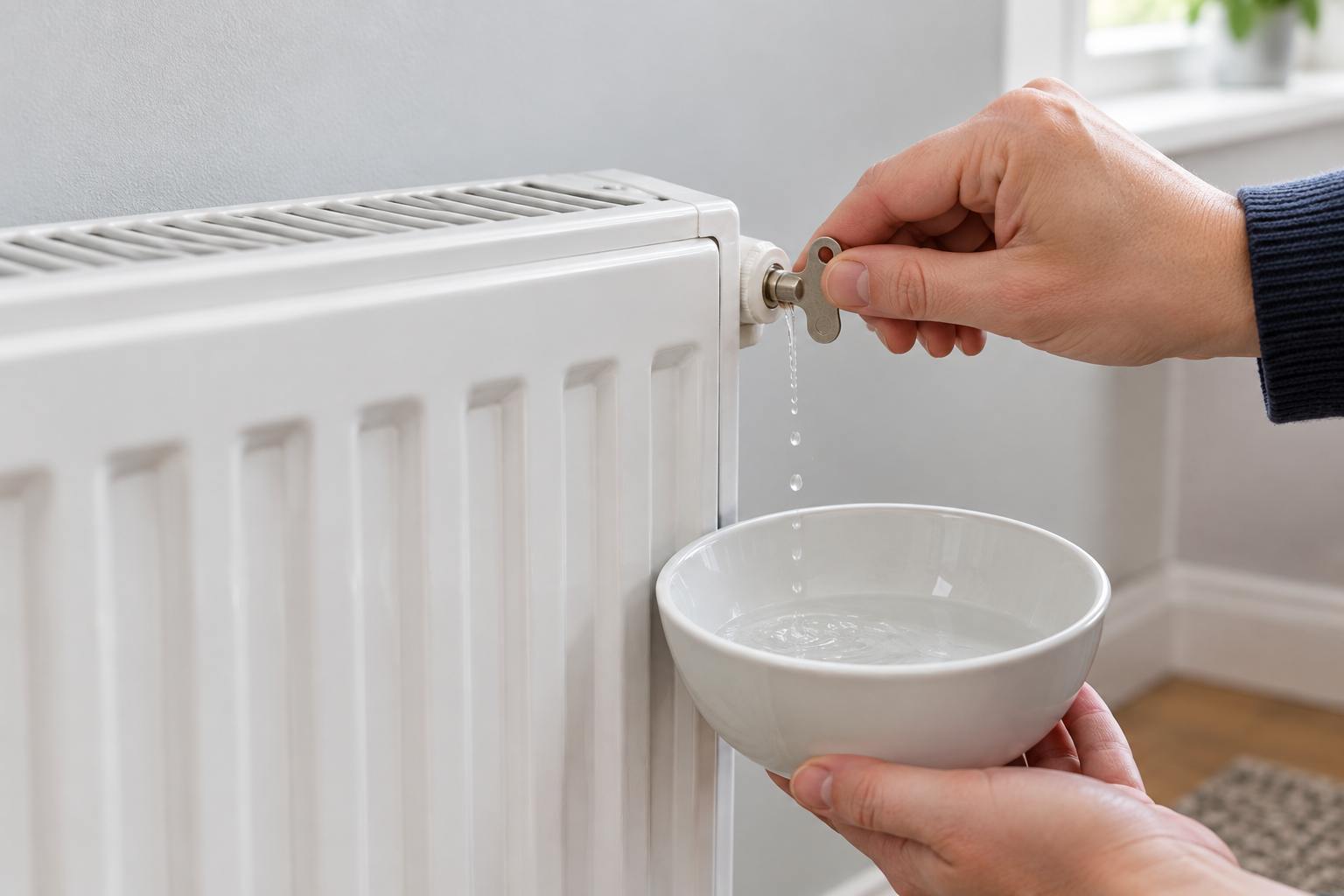
A radiator that is cold at the top and warm lower down almost always has trapped air sitting in the upper section. Bleeding is the fix for that specific pattern. It is one of the simplest jobs on a UK central heating system, needs almost no tools, and usually takes a few minutes per radiator once you know the order and what to do about boiler pressure afterwards.
This guide covers exactly when bleeding helps, the correct sequence, how to top the system back up, and the situations where bleeding will not solve the problem so you do not waste time on the wrong fix.
If you are not sure whether the issue is air, sludge, a stuck valve or system imbalance, start with the house cold diagnostic first. It points you to the most likely cause in a couple of minutes.
When you should bleed a radiator
Bleed a radiator when:
- The top is cold (or noticeably cooler) while the bottom is warm
- You hear gurgling, bubbling or a light hissing from the radiator or nearby pipework as the heating comes on
- One radiator takes much longer to warm than the others and stays cooler at the top
These are the classic signs of trapped air. Air is lighter than water, so it collects at the highest points in the system and blocks hot water from filling the full panel.
Do not bleed a radiator that is:
- Hot at the top and cold at the bottom (that is almost always sludge — see radiator cold at the bottom)
- Completely stone cold while the pipes feeding it are also cold (more likely a closed or stuck valve — see one radiator not working)
- Lukewarm all over while others are properly hot (often imbalance or low flow — see how to balance radiators properly)
Bleeding the wrong pattern wastes time and can drop system pressure for no gain.
What you need
- A radiator bleed key (square or flat, depending on the valve — available from any hardware shop or supermarket for a couple of pounds)
- An old cloth or small towel
- A container or cup (optional but useful)
- Access to the boiler pressure gauge and filling loop afterwards
That is all. You do not need to drain the system or turn the water off at the mains.
Safety first
Turn the heating off and let the radiators cool before you start. Bleeding a hot system risks scalding water and a running pump can pull more air into the circuit while you work. If you smell gas at any point, stop, leave the property and call the National Gas Emergency Service on 0800 111 999.
How to bleed a radiator — step by step
- Turn the heating off and wait until the radiators are cool to the touch.
- Locate the bleed valve. It is the small square or slotted valve at the top of one end of the radiator (usually the opposite end from the thermostatic valve).
- Hold a cloth under the valve to catch any water.
- Insert the bleed key and turn it slowly anti-clockwise (usually a quarter to half a turn is enough). You should hear a hiss of escaping air.
- Keep the key in place and wait. As the air leaves, water will start to appear. The moment a steady trickle of water comes out, close the valve by turning the key clockwise. Do not open it further than needed.
- Wipe any drips and move to the next radiator.
Work in this order:
- Start with the ground-floor radiator nearest the boiler
- Work outward along the ground floor
- Then do the upstairs radiators, beginning with the one nearest the boiler and moving outward
Air rises, so upstairs radiators often hold more of it even when the cold symptom first appears downstairs. Doing the ground floor first helps push air upward so the upstairs bleed is more effective.
Bleeding all the radiators and managing system pressure
If several radiators show the cold-top pattern, or you are doing the annual autumn check before the heating season starts, it is better to bleed the whole system in one session rather than chasing individual radiators over several days.
Order still matters. Follow the same sequence even when doing every radiator: ground floor nearest the boiler first, then the rest of the ground floor, then upstairs in the same nearest-to-furthest order. This systematically moves air toward the highest points so the final upstairs radiators release the most air rather than trapping it further along the circuit.
Pressure will drop more when you bleed everything. Each radiator releases a small amount of water along with the air. On a typical three- or four-bedroom UK house, bleeding every radiator can drop the cold system pressure by 0.3–0.6 bar, sometimes more if the radiators were particularly full of air. Most sealed systems should sit between 1.0 and 1.5 bar when cold. If the gauge falls below 1.0 bar part-way through, the boiler may refuse to fire or run inefficiently once you switch the heating back on.
Top up at the right time. You have two practical options:
- Bleed everything first, then top up once at the end (preferred for most homes). This keeps the process simple. Note the pressure before you start, bleed every radiator in order, then restore pressure to the middle of the normal cold range (around 1.2–1.3 bar is ideal for most systems).
- Top up part-way if pressure falls below 1.0 bar. If the gauge drops too low while you are still working, pause, restore pressure to about 1.2 bar, then continue. Avoid topping up after every single radiator — that introduces unnecessary fresh water and oxygen.
How to top the system up correctly
- Locate the filling loop (usually a flexible silver hose with two small valves under or near the boiler).
- Open both valves slowly while watching the pressure gauge.
- Close both valves firmly as soon as the gauge reaches the target cold pressure.
- Never leave the filling loop open.
If pressure falls again within a day or two after a full bleed and top-up, the system is losing water somewhere. That is no longer a bleeding issue — see why your boiler keeps losing pressure.
After a full-system bleed
Once every radiator has been bled and pressure is restored, turn the heating back on and check that each radiator now heats evenly from bottom to top. Any radiator that still shows a cold top after a proper full bleed almost certainly has another problem (stuck valve, sludge, or severe imbalance). At that point move to the relevant diagnostic rather than bleeding again.
A full-system bleed once a year, done in the correct order with pressure restored at the end, is usually enough for most UK homes. You should not need to repeat the whole process every few weeks. If air keeps returning quickly, treat it as a pressure-loss problem rather than normal maintenance.
Quick decision tool: is it air or something else?
Use this before you start:
| What you feel / hear | Most likely cause | First action |
|---|---|---|
| Cold at the top, warm at the bottom | Trapped air | Bleed |
| Hot at the top, cold at the bottom | Sludge / magnetite | Do not bleed — see radiator cold at the bottom |
| Completely cold, pipes also cold | Stuck or closed valve | Check TRV pin and lockshield — one radiator not working |
| Lukewarm all over, others fine | Flow / balance issue | Bleed if top is cooler, then consider balancing |
| Several radiators slow or uneven | System imbalance or low pressure | Check pressure, bleed highest radiators, then balance |
| Air returns within days | Ongoing pressure loss or leak | Investigate pressure drop — do not just keep bleeding |
What if bleeding does not fix it?
If the top is still cold after a proper bleed and the pressure is correct, the air was not the (only) problem. Common next causes:
- A partially seized TRV pin restricting flow
- Lockshield valve closed or nearly closed
- Sludge further down the panel or in the pipework
- System imbalance sending most of the flow to other radiators
- Low boiler pressure or a weak pump
Work through the checks in radiator not heating properly in order. If the pattern is cold downstairs and hot upstairs, the full diagnostic is in why your upstairs is warm but downstairs stays cold.
Repeated air after bleeding is a warning sign. Fresh air entering the system usually means a small leak or a pressure fault that needs finding rather than endless topping-up and bleeding.
How often should you bleed radiators?
Once a year at the start of the heating season is enough for most homes. Bleed again if a specific radiator develops the cold-top pattern or starts gurgling. You should not need to bleed monthly. If you do, treat it as a pressure or leak problem, not a normal maintenance task.
Common mistakes that waste time
- Bleeding while the heating is on and the pump is running
- Opening the valve too far or leaving it open too long (drops pressure unnecessarily)
- Bleeding a radiator that is already hot at the top
- Forgetting to restore boiler pressure afterwards
- Assuming every cold radiator is air when the pattern shows sludge or a stuck valve
- Topping up after every single radiator instead of once at the end of a full-system bleed
When to call a heating engineer
Call a Gas Safe registered engineer if:
- Pressure will not hold after topping up
- The boiler shows a fault code or keeps locking out
- Several radiators remain cold after bleeding and basic valve checks
- You suspect a leak you cannot find
- The system needs a power flush because of widespread sludge
Bleeding itself is a homeowner job. Persistent pressure loss, internal boiler faults and full-system cleaning are not.
Aftercare and related fixes
Once the radiators heat evenly from top to bottom, the next most useful step in many UK homes is balancing the system so every radiator gets a fair share of flow. That is covered step-by-step in how to balance radiators properly.
If the radiators are now working but the house still feels cold or loses heat quickly, the problem has moved from distribution to heat loss. Draughts, letterboxes, loft hatches and cold floors are the usual suspects — start with how to find hidden draughts and the wider how to keep a UK home warm for cheap.
Frequently asked questions
How do I bleed a radiator without a key?
Most modern valves take a standard square radiator key. Some older valves have a flat slot that accepts a flat-head screwdriver. Do not force a valve that will not turn — that risks snapping the spindle.
Should I bleed radiators with the heating on or off?
Off, and cool. A running pump can draw more air in while the valve is open, and hot water under pressure is a scald risk.
Which radiators should I bleed first?
Ground floor nearest the boiler, then the rest of the ground floor, then upstairs in the same nearest-to-furthest order.
Why is my radiator still cold after bleeding?
Either the air was not the main problem (sludge, stuck valve, imbalance or low pressure) or air has already returned because the system is losing pressure. Re-check the pattern and the boiler gauge.
Can bleeding a radiator damage the boiler?
No, provided you restore pressure afterwards and do not leave the filling loop open. Repeated unnecessary bleeding and topping-up introduces fresh oxygen, which encourages corrosion over time, so only bleed when the symptoms match.
How much water should come out?
Only a trickle. Once a steady stream of water appears, close the valve. You are releasing air, not draining the radiator.
Should I top up the pressure after every radiator or only at the end?
Only at the end of a full-system bleed, unless the gauge falls below 1.0 bar while you are still working. Continuous topping-up is unnecessary and introduces extra oxygen into the system.
Bleeding is a five-minute job when it is the right fix. Done in the correct order, with pressure restored afterwards, it restores full heat output to radiators that were only half working and stops the boiler running longer than it needs to. If the cold pattern is different, use the diagnostic links above rather than repeating the same step.